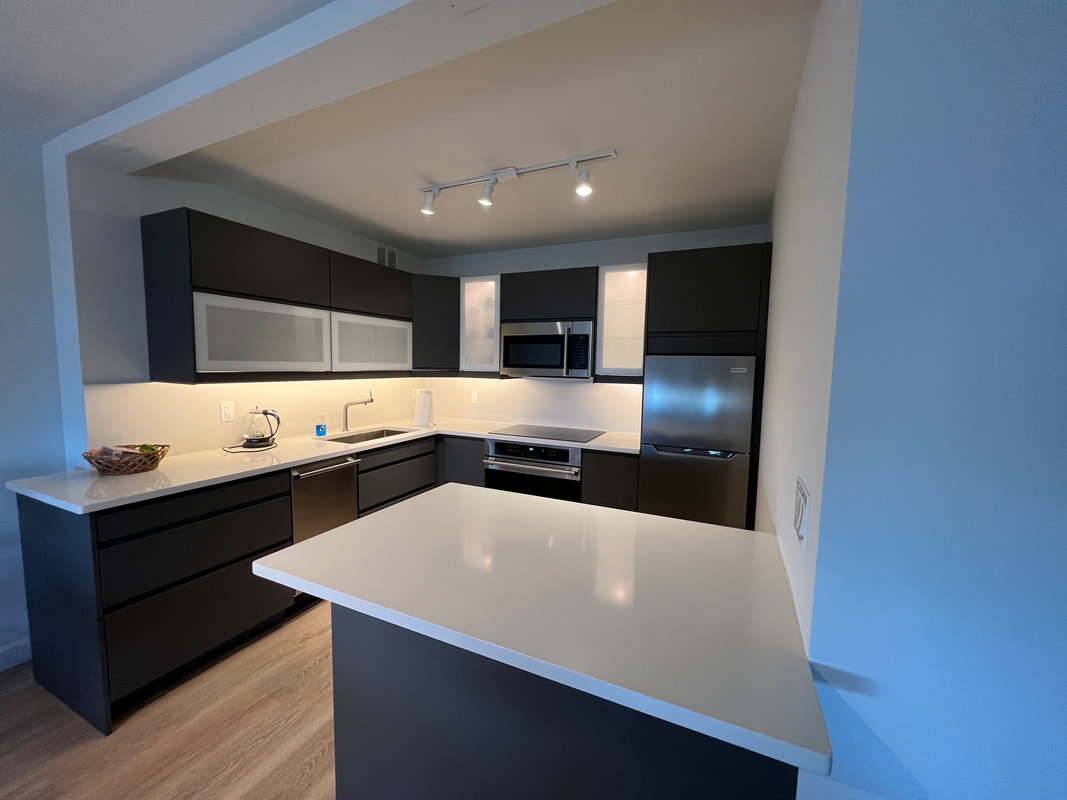
"Modern" is one of those words that means everything and nothing in a kitchen remodel conversation. It can mean industrial-cool West Loop loft. It can mean Japandi-calm Gold Coast condo. It can mean transitional-modern Lincoln Park bungalow. Ask ten different Chicago homeowners what they want and nine of them will say "modern" — then show you nine completely different Pinterest boards.
After 500+ Chicago kitchen installations since 2013, here's what I've learned: modern in Chicago is not a single look — it's a set of principles applied differently depending on your building type, neighborhood, and how you actually live in your kitchen. This guide defines those principles, then gives you 10 concrete ideas ranked by cost and impact — with what each costs in Chicago, whether it needs a permit, and which building types it works best in.
Houzz 2026
Zonda Cost vs. Value 2025
First: What "Modern" Actually Means in Chicago — 4 Substyles
Before you spend a dollar, get clear on which version of modern you want. Chicago's four dominant modern kitchen substyles each have distinct material palettes, price points, and building type fits. Most homeowners landing on "modern" are actually describing one of these four:
Warm Modern
The dominant substyle in Assembly Squad's 2026 project mix. Clean flat-front or Shaker cabinets in warm white or white oak, quartz in warm tones (think Calacatta Laza or Cambria Ella), unlacquered brass hardware, 3000K recessed lighting. Modern structure, warm soul.
- Best building type: bungalow, greystone, courtyard
- Cabinet: white oak Shaker or flat-front, warm white paint
- Counter: Cambria warm quartz or quartzite
- Hardware: unlacquered brass or satin gold
- Budget range: $45K–$85K all-in
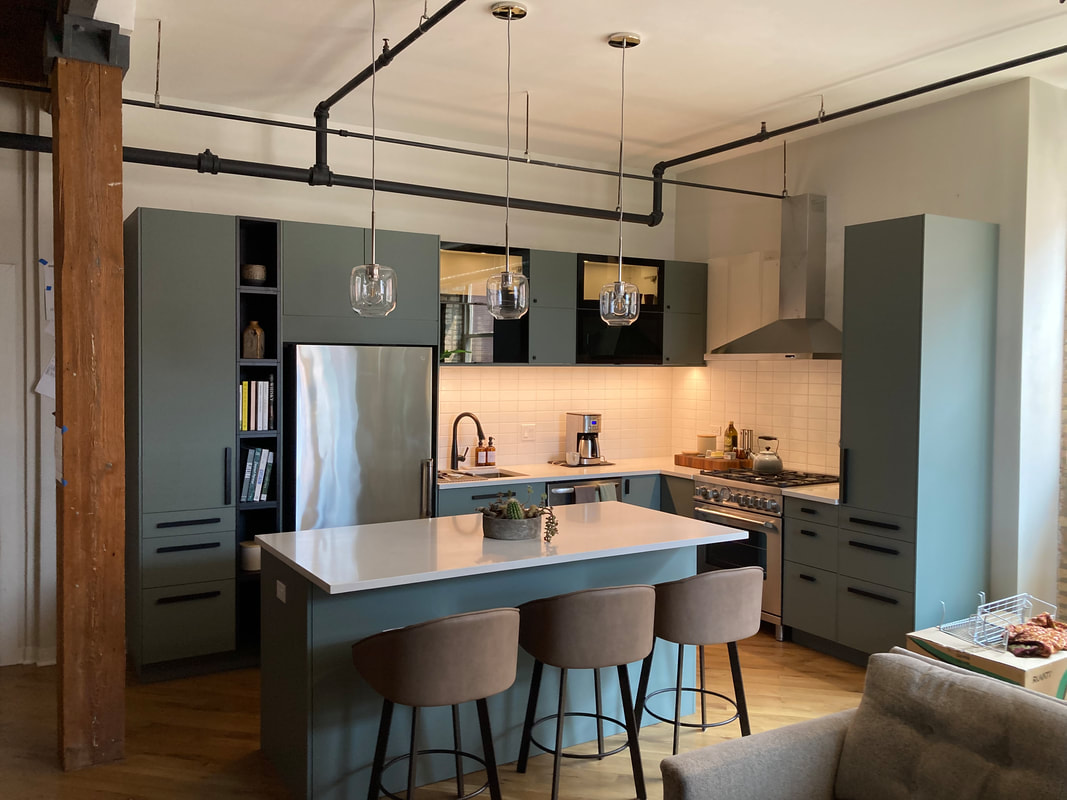
Industrial Modern
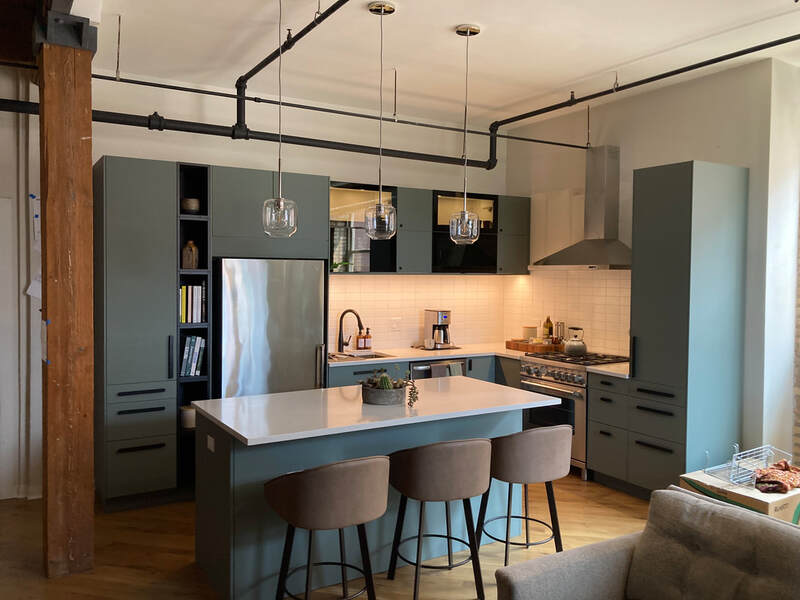
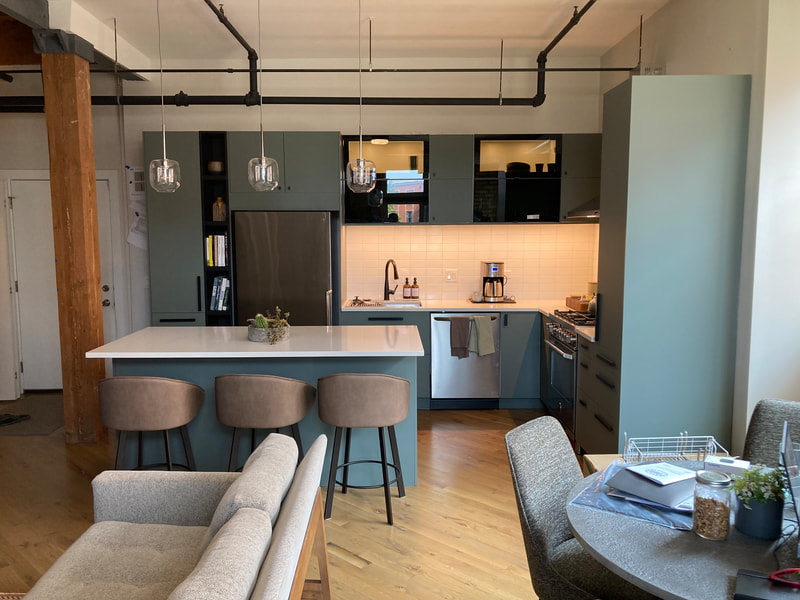
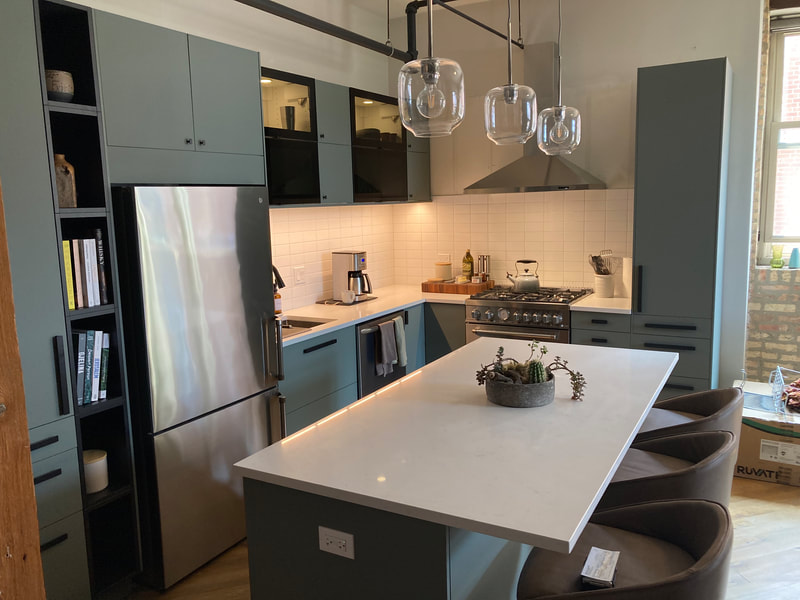
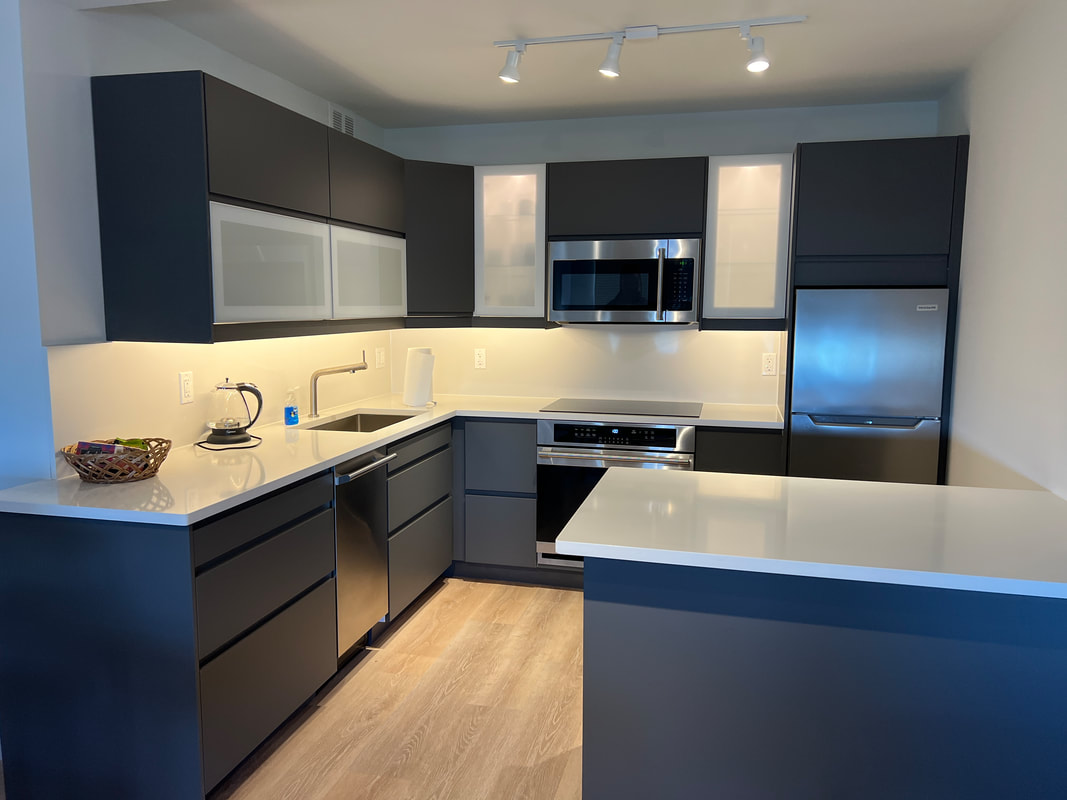
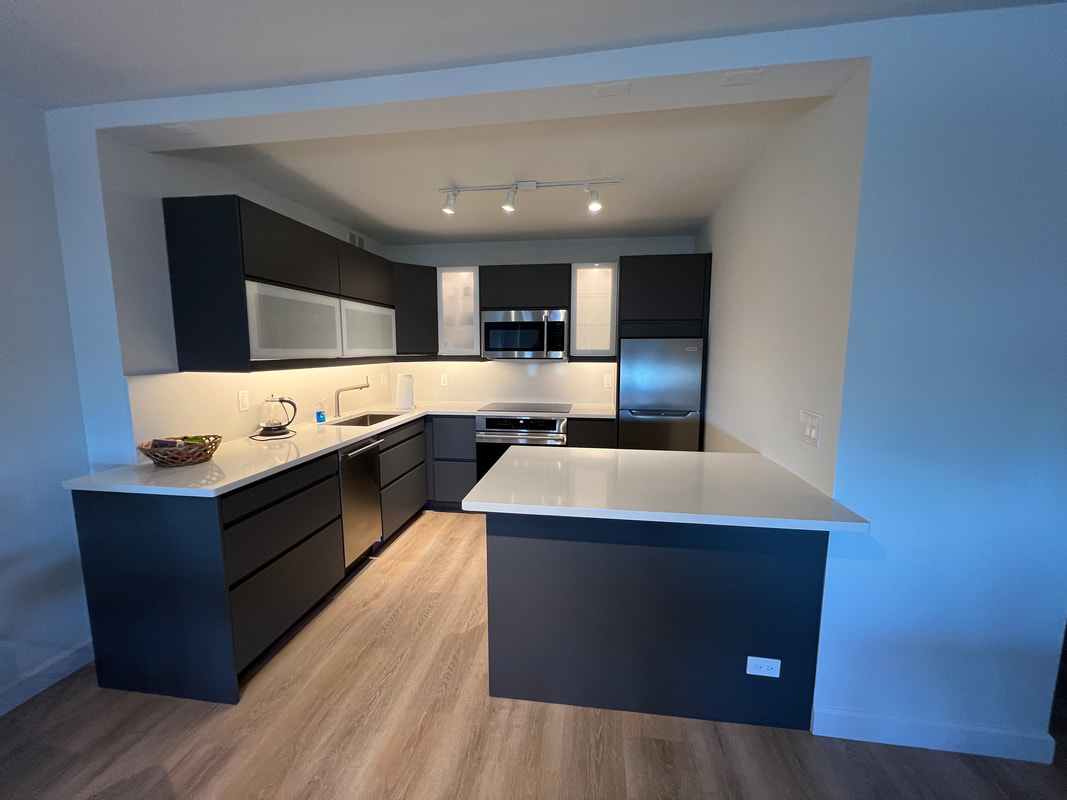
The West Loop signature. Exposed brick or concrete texture married to flat-front dark or two-tone cabinets, black metal fixtures, concrete or honed stone countertops. Raw materials refined into sophistication. Works powerfully in lofts and converted industrial spaces.
- Best building type: loft, converted industrial, modern condo
- Cabinet: flat-front in charcoal, navy, or black
- Counter: concrete, honed Nero Marquina, or dark quartzite
- Hardware: matte black or aged iron
- Budget range: $55K–$95K all-in
Japandi
Japanese minimalism meets Scandinavian warmth. The dominant modern style in Chicago's premium condo market. Handle-free flat-front cabinets in warm white or natural wood veneer, integrated appliances, minimal upper cabinets, natural stone or porcelain slab countertops. Nothing unnecessary, everything intentional.
- Best building type: high-rise condo, modern mid-rise
- Cabinet: integrated handle profile or push-to-open
- Counter: porcelain slab or light quartzite
- Hardware: none (integrated handles) or minimal brushed nickel
- Budget range: $60K–$110K all-in
Transitional Modern
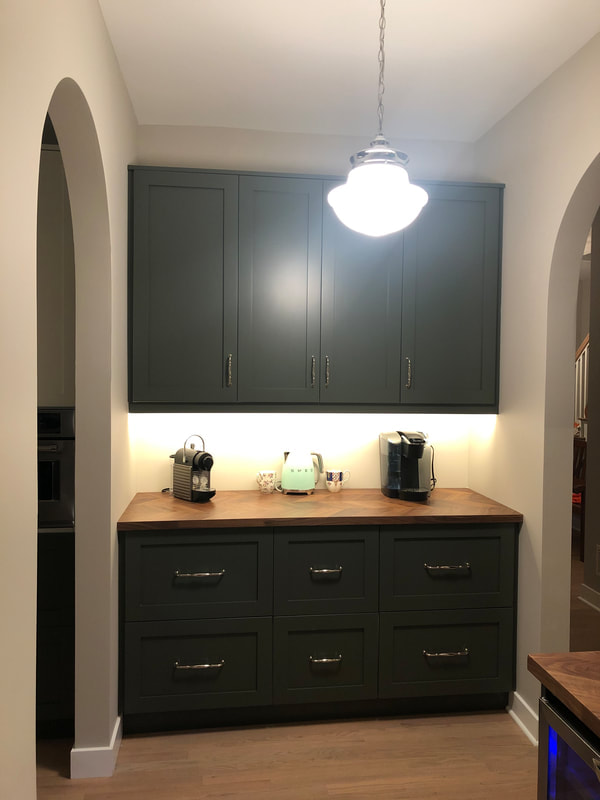
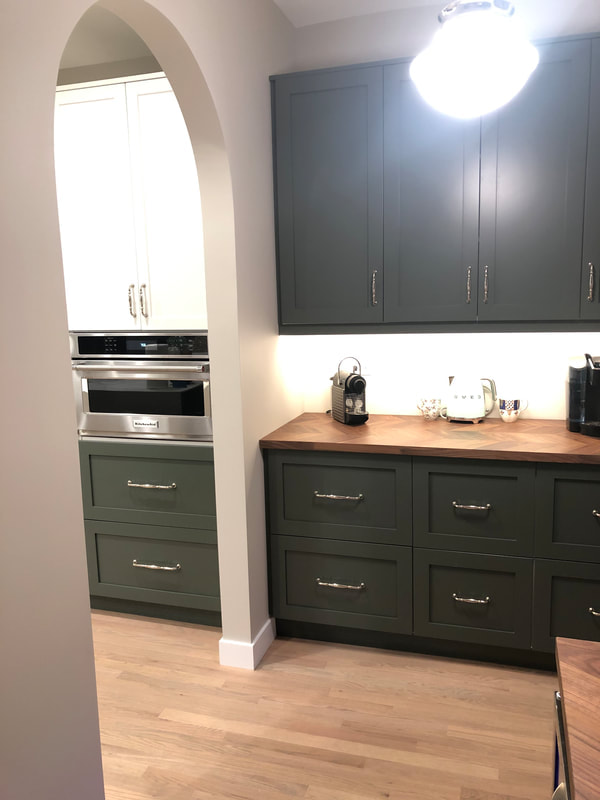
The most flexible substyle — traditional Shaker structure with thoroughly modern finishes. This is how you modernize a vintage Chicago kitchen without erasing the building's character. Painted Shaker in soft sage, warm gray, or greige, quartz counters, subway tile with a modern twist (satin, large-format, or in a running bond), brushed nickel hardware.
- Best building type: vintage apartment, two-flat, older bungalow
- Cabinet: painted Shaker in sage, warm gray, or soft white
- Counter: white or warm quartz
- Hardware: brushed nickel or satin brass
- Budget range: $35K–$65K all-in
□ Viktor's Advice: Pick Your Substyle First
Before you look at a single cabinet door or countertop sample, identify which of these four substyles resonates. Then every decision — hardware finish, cabinet profile, countertop material, backsplash format — becomes an easy "does this fit my substyle?" Yes or no. Without a substyle anchor, you end up with a kitchen that's trying to be everything and feels like nothing. Come see samples at our Lincoln Park studio at 2315 N Southport Ave — we have all four represented.
Not Sure Which Modern Style Fits Your Chicago Home?
Free consultation — we visit your home, assess your building type, and walk you through samples that match your space. From condo galleys to bungalow kitchens, we've done them all.
(312) 544-9150 Schedule online → assemblyserviceil.comModern Kitchen Ideas by Building Type
Chicago's building stock is unlike any other American city — and which modern ideas work depends heavily on where you live. Here's how modern kitchen design translates across the four building types we work in most:
□️ Condo / High-Rise
- Best modern ideas: Flat-front cabinets, integrated appliances, full-height backsplash, pendant lighting
- HOA reality: Every structural and plumbing change requires board approval — submit drawings early (add 4–6 weeks)
- Constraint: Plumbing stacks often can't move — modern layout within existing footprint
- Lighting key: High-rises often have low natural light — 4-inch recessed LEDs plus undercabinet strips are essential
- Best substyle: Japandi or Warm Modern — both maximize perceived space and light
- Typical budget: $45K–$85K for a complete modern kitchen update
□ Bungalow / Two-Flat
- Best modern ideas: Open concept wall removal, warm modern cabinets, waterfall island, wood floors
- Load-bearing reality: Chicago bungalows have load-bearing walls in unexpected places — always assess before any opening
- Modern vs. character: Best bungalow modern kitchens honor the building's vintage bones — original trim, period colors — while updating everything functional
- Best substyle: Warm Modern or Transitional Modern — flat-front often feels out of place in a 1920s bungalow
- Permit note: Wall removal requires Standard Plan Review — 4–6 weeks
- Typical budget: $50K–$95K for a full modern bungalow kitchen
□️ Greystone / Brownstone
- Best modern ideas: Warm Modern substyle, custom Illinois-made cabinetry for non-standard dimensions, quartzite countertops
- Non-standard sizing: Greystone kitchens rarely match standard cabinet widths — Illinois-made custom sizing is not optional, it's essential
- Wall treatment: Plaster walls require different anchoring for upper cabinets than drywall — masonry screws into the limestone substrate
- Best substyle: Warm Modern — respects the building's historical character while fully modernizing function
- Ceiling height: High ceilings (9–10 ft) are an advantage — use tall uppers (42-inch) to make a modern statement
- Typical budget: $55K–$100K including plaster repair and custom cabinet sizing
□ Vintage Apartment / Courtyard
- Best modern ideas: Modern hardware swap (biggest bang for buck), lighting upgrade, backsplash replacement, countertop upgrade
- Renter vs. owner: Renters: hardware + lighting + paint only. Owners: consider full cabinet replacement — IKEA SEKTION flat-front or Illinois-made
- HOA reality: Shared plumbing stacks — coordinate with building management for any plumbing work
- Best substyle: Transitional Modern — respects the building's vintage character while updating finishes
- Budget entry point: $8K–$18K for hardware + lighting + backsplash + countertop update, no permit needed
The 10 Modern Kitchen Ideas — Ranked by Cost & Impact
Here they are in order from lowest investment to highest — with Chicago-specific pricing, permit requirements, and which building types each works best in.
Modern Hardware Swap — $500–$1,500
The single fastest way to modernize a Chicago kitchen — and the only update that requires zero permits, zero contractor coordination, and zero building approval. New hardware transforms the perceived style of a kitchen more than any other single element. Outdated brass or oil-rubbed bronze knobs age a kitchen by 20 years. The right modern hardware ages it forward.
- Matte black: Still strong but peaking — works in Industrial Modern and Transitional Modern. Don't mix with warm wood tones.
- Brushed nickel / satin nickel: The reliable modern choice — works in every substyle, pairs with anything, will never look wrong.
- Unlacquered brass: The 2026 Warm Modern statement. It patinas naturally over time — that's the point. Pairs beautifully with white oak cabinets and warm quartz countertops. Growing fast in Lincoln Park and Lakeview projects.
- Champagne bronze: The middle ground between brass and gold — warmer than nickel, subtler than unlacquered brass. Popular in Transitional Modern.
- No hardware (push-to-open): The Japandi move. Requires push-to-open hardware installed inside cabinet doors — about $15–$25 per door. Truly minimal, truly modern.
- Cost in Chicago: Hardware itself $3–$30 per piece. Professional installation if needed: $200–$400. For 30 cabinets with mid-range hardware: $600–$1,200 total.
Layered Lighting Upgrade — $2,500–$5,000
No modern kitchen idea has a higher perceived impact-to-cost ratio than lighting — especially in Chicago, where we average only 84 clear sunny days per year. A modern kitchen with dated recessed can lights and a single overhead fixture looks dark and unfinished regardless of how good the cabinets are. Layered lighting is what separates a truly modern kitchen from one that just has modern cabinets.
- Recessed LEDs — 4-inch, not 6-inch: Modern kitchens use 4-inch cans because they're less visually intrusive. Space them every 4 feet. 2700K for warmth, 3000K for brighter work light. For a standard Chicago galley, 6–8 cans covers it well.
- Undercabinet LED strips: The most underused modern upgrade. Eliminates counter shadows, makes the backsplash glow, creates depth in the kitchen. LED tape strips: $200–$400 installed. The single biggest bang-for-buck lighting move.
- Pendant over the island: One statement pendant (or two matching pendants for a longer island) anchors the modern look and defines the space. Size matters — for an 8-foot ceiling, keep pendants 8–10 inches in diameter. For 9-foot ceilings, go up to 12–14 inches.
- Color temperature: Modern kitchens in Chicago use 2700K–3000K (warm white). Avoid 4000K–5000K (cool white) — it makes the kitchen feel clinical and washes out warm wood tones and brass hardware.
- Permit: New circuits or recessed light additions require an electrical permit. Express Permit through the City of Chicago — 3–5 business days.
- Cost in Chicago: 8 recessed 4-inch LEDs + undercabinet strips + one pendant, professionally installed: $2,500–$4,500.
Modern Backsplash — $800–$2,500
The backsplash is the part of your kitchen that gets the most Instagram attention and costs the least to change. It's also the element that most clearly signals "modern" vs. "dated" — subway tile in a classic running bond reads 2015; large-format porcelain or a full-height slab reads 2026. For a standard Chicago kitchen backsplash (approximately 25–35 square feet), this is one of the most cost-effective modernization moves available.
- Full-height slab backsplash: Countertop material extended floor-to-ceiling behind the range — no grout lines, seamless, sculpture-like. The most impactful modern backsplash move. Works best with quartz or porcelain slab (not marble — too fragile for behind-stove heat). Cost: $800–$1,800 for the backsplash zone installed, using remaining countertop slab material.
- Large-format porcelain tile (12×24 or 24×48): Fewer grout lines = more modern. Rectified edges for tight joints. Stacked (running with zero offset) or vertical orientation reads more contemporary than traditional running bond. Cost: $12–$22/sqft installed.
- Zellige tile: The 2026 antidote to sterile modern. Handmade Moroccan tile with natural variation in color and surface — textured, imperfect, warm. Pairs beautifully with flat-front cabinets as the organic counterpoint to precise geometry. More expensive: $25–$45/sqft installed.
- Fluted / ribbed ceramic: The current statement move. Vertical ribbing adds texture and dimension without color. Works in Warm Modern and Japandi substyles. Cost: $18–$30/sqft installed.
- Subway tile (modern version): Still valid — but only in satin finish (not glossy), stacked or vertical bond (not traditional offset), and in non-white colors (sage, warm gray, greige). Classic white horizontal subway tile is officially dated in a modern Chicago kitchen.
Flat-Front Cabinet Door Reface — $4,000–$12,000
If your cabinet boxes are structurally sound but your doors look dated, refacing with modern flat-front (slab) doors is the fastest path to a modern-looking kitchen without a full gut. This replaces the door faces and drawer fronts while keeping the existing box structure and layout. Not every home is a candidate — cabinet boxes need to be solid and properly sized — but when it works, it's transformative.
- What refacing includes: New flat-front doors and drawer fronts, new hinges (soft-close), veneer wrap on exposed box sides, and new hardware. Does NOT include box replacement or any plumbing/electrical work.
- Illinois-made flat-front doors: Assembly Squad sources Illinois-made painted MDF or wood-veneer flat-front doors — zero tariff, 4–6 week lead, custom-sized to your existing boxes. This is how we deliver the full modern flat-front look without full cabinet replacement cost.
- European import alternative: Popular Eurostyle flat-front doors from Germany and Scandinavia. Carry 25%+ import tariff in 2026. Lead time 8–14 weeks. We don't recommend this path right now — Illinois-made performs equally well at comparable or lower cost after tariffs.
- Full replacement vs. reface: If your boxes are plywood construction and properly sized, reface. If they're particleboard or mis-sized for your space, full replacement is worth the additional cost — you get the right sizing, better materials, and a fresh start.
- Cost in Chicago: Reface only: $4,000–$8,000 for a standard Chicago kitchen. Full flat-front cabinet replacement with Illinois-made: $18,000–$35,000 including installation.
⚠️ 2026 Tariff Warning: European Cabinet Fronts
- Import tariffs at 25%+ apply to cabinet doors and fronts from European manufacturers including popular German and Scandinavian brands
- On a 30-door kitchen, this adds $1,500–$4,000 to your cabinet front cost versus Illinois-made alternatives
- Lead times on European imports have extended to 8–14 weeks in 2026 due to customs processing and supply chain strain
- Illinois-made flat-front doors: zero tariff, 4–6 week lead, custom-sized, equivalent or better quality — Assembly Squad's standard specification
Modern Countertop Replacement — $55–$95/sqft Installed
Nothing dates a kitchen faster than outdated laminate, dark granite from the 2000s, or cracked tile countertops. And nothing modernizes it faster than a clean quartz or porcelain slab installation. The modern Chicago market in 2026 has a clear material hierarchy — and it's significantly shaped by tariff impacts on imported stone.
| Material | Cost Installed | Tariff Status | Durability | Best For |
|---|---|---|---|---|
| Cambria Quartz | $65–$95/sqft | ✅ Zero — Made in MN | Excellent | All modern substyles |
| Illinois-made quartz | $55–$80/sqft | ✅ Zero — Made in IL | Excellent | Budget-conscious modern |
| Porcelain slab | $65–$110/sqft | ✅ Low/Zero (domestic) | Best — scratch/heat proof | Japandi, Industrial Modern |
| Quartzite (imported) | $85–$140/sqft | ⚠️ 25%+ tariff | Good — needs sealing | Luxury Warm Modern |
| Calacatta marble | $95–$180/sqft | ⚠️ 25%+ tariff | Poor — etches, stains | Decorative only |
| Concrete | $85–$120/sqft | ✅ Zero — cast locally | Good — needs sealing | Industrial Modern only |
- The 2026 smart pick: Cambria quartz in warm white tones (Ella, Whitesdale, Torquay) — Minnesota-made, zero tariff, looks like Calacatta marble, dramatically outperforms it for durability and maintenance. The Warm Modern countertop.
- The rising star: Large-format porcelain slab — harder than natural stone, zero porosity, can be used as backsplash material too (same slab, no grout lines). The Japandi countertop.
- Tariff note: Natural stone countertops from Italy, Brazil, and Turkey carry 25%+ import tariffs in 2026. Your quoted price may include this — always ask where the stone was quarried and processed.
Integrated Appliance Upgrade — $3,000–$8,000 Labor + Appliances
The defining characteristic of the Japandi and high-end Warm Modern substyle is that you can't easily see the appliances. Panel-ready refrigerators and dishwashers disappear behind custom cabinet fronts. Flush-mounted induction cooktops eliminate the range hood visual. Microwave drawers drop into the island base. When appliances stop announcing themselves, the kitchen feels more like a room and less like a workstation.
- Panel-ready refrigerator: Custom panel matches your cabinet doors — refrigerator becomes another cabinet. Thermador, Miele, Sub-Zero all offer panel-ready columns. Labor to install custom panels: $800–$1,500. Appliance cost separate.
- Panel-ready dishwasher: The most accessible integrated upgrade — adds $200–$600 in labor over a standard dishwasher installation. Makes a visible difference every day.
- Induction cooktop (flush-mounted): The modern cooktop. Flush-mounted into the countertop with no raised edge, precise temperature control, easy to clean. Requires a 240V dedicated circuit — Express Permit territory. Cooktop: $800–$2,500. Installation: $400–$700 including electrical.
- Microwave drawer: Installed in a base cabinet or island — eliminates the over-range microwave that visually clutters the backsplash and blocks the range hood. Particularly effective in Japandi kitchens where the backsplash should be uninterrupted.
- Chicago HOA note: Appliance upgrades that don't affect plumbing or gas lines typically don't require HOA approval in condo buildings — but always confirm with your building management before ordering. Electrical changes do require HOA notification in most buildings.
Waterfall Island Edge — $800–$2,000 per Side
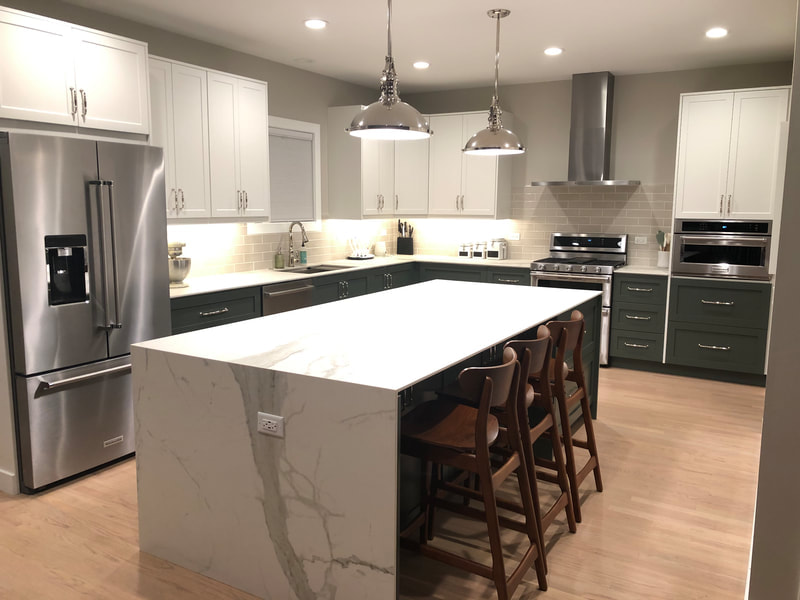
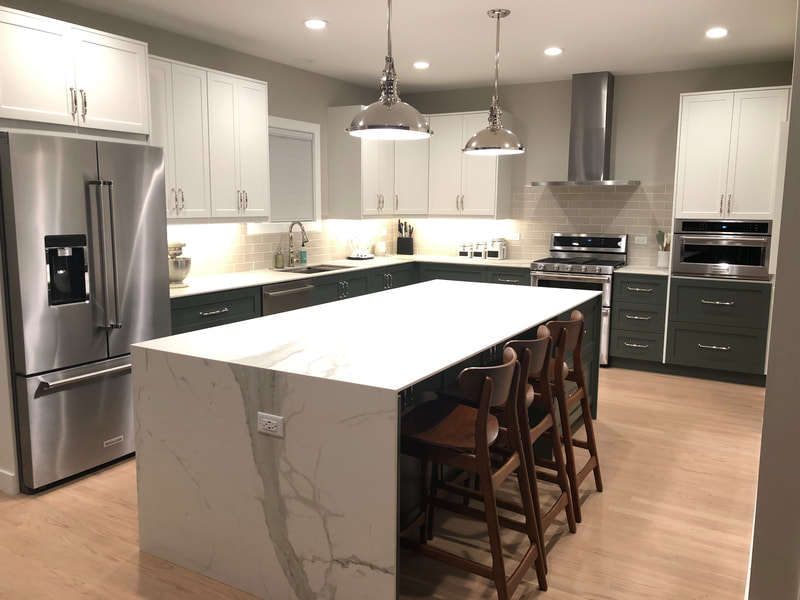
The waterfall edge — countertop slab continuing vertically down the side of the island to the floor — has moved from luxury-only to mainstream in Chicago's premium neighborhoods. It's the most recognizable modern kitchen feature and, with the right material, dramatically elevates the visual weight and sophistication of the island. Quartz waterfall edges have become the 2026 mid-range standard in Lincoln Park and Lakeview projects.
- Material matters most: Waterfall edges work best with materials that have consistent veining throughout the slab (quartz, quartzite, porcelain). A waterfall in a material where the veining doesn't match at the miter joint looks amateur — always ask to see the full slab before approving a waterfall cut.
- One side vs. two: One-sided waterfall (typically the seating side) is the standard choice and more cost-effective. Two-sided waterfall is more expensive but creates a fully finished, sculpture-like island.
- Island size requirement: The island needs to be wide enough to justify the waterfall — minimum 36 inches, ideally 42+ inches. A narrow island with a waterfall looks awkward.
- Chicago pricing 2026: Quartz waterfall edge, one side: $800–$1,400 additional above standard countertop cost. Quartzite or natural stone: $1,200–$2,000 per side. Porcelain slab: $900–$1,600 per side.
- Permit: Countertop replacement alone — no permit required. If combined with new island installation (plumbing or electrical in the island), Express Permit: 3–5 business days.
Modern Kitchen Repaint — $800–$2,200
Paint is the fastest route to modern when your cabinets are in good condition and you're working with a tight budget. A professional cabinet paint job — proper prep, primer, and finish coat with a sprayer — transforms the kitchen in 3–5 days with zero permits and minimal disruption. The 2026 modern color palette in Chicago kitchens has moved decisively away from bright white toward warm, nuanced tones.
- Warm White (the #1 choice): Sherwin-Williams Alabaster (SW 7008), Benjamin Moore White Dove (OC-17), or Benjamin Moore Chantilly Lace (OC-65) for the purest modern white. These read warm in Chicago's northern-exposure kitchens without going yellow.
- Sage Green (the 2026 statement): SW Rosemary, BM Tranquility, or Farrow & Ball Mizzle. The color of the moment in Chicago transitional modern kitchens. Pairs with brushed nickel or unlacquered brass hardware, white quartz countertops.
- Warm Greige: BM Revere Pewter is played out — try SW Accessible Beige (SW 7036) or BM Pale Oak (OC-20) for a more sophisticated modern greige that works beautifully with wood elements.
- Navy for the island: Two-tone is still the dominant modern approach for kitchens with islands. White or warm white perimeter cabinets + navy island (BM Hale Navy HC-154 or SW Naval SW 6244). The navy island grounds the space and adds the modern contrast.
- Chicago condo note: Low-VOC paint is required by most Chicago condo building HOAs — and frankly better for everyone in a space with limited ventilation. Benjamin Moore Aura and Sherwin-Williams Emerald are the professional standards. Ask your contractor which they're using.
- Cost in Chicago: Professional cabinet painting (spray-applied, proper prep): $1,500–$3,500 depending on cabinet count. Wall and ceiling painting: $800–$1,800. Budget around $2,200–$4,500 for a complete kitchen repaint professionally done.
Full Modern Cabinet Replacement — $18,000–$45,000 All-In
When the cabinets are structurally compromised, sized wrong for the space, or when you want to completely rethink the layout — full cabinet replacement is the right move. This is the single biggest aesthetic transformation available in a kitchen remodel, and with Illinois-made custom cabinetry, it's now more accessible and faster than ever.
- Illinois-made custom cabinets — Assembly Squad's standard spec: Plywood box construction (not particleboard), dovetail drawer boxes, soft-close hardware standard. Custom-sized for Chicago's non-standard bungalow, greystone, and vintage apartment dimensions. Flat-front or Shaker door profiles. Zero import tariff. 4–6 week lead time. Available in 50+ paint colors or real wood species.
- IKEA SEKTION flat-front: The most cost-effective route to a true modern flat-front cabinet. Assembly Squad has installed SEKTION since 2013 — we know every quirk. AXSTAD (matte white/gray) and KUNGSBACKA (anthracite) are the two dominant modern fronts. Boxes: $3,000–$6,000. Labor: $4,000–$8,000 for assembly and installation.
- Semihandmade upgrade: IKEA SEKTION boxes + Semihandmade custom-painted or wood-veneer fronts = the best of both worlds. Budget: $12,000–$22,000 all-in including installation. The most popular premium-modern upgrade we offer for budget-conscious clients who want a fully custom look.
- Layout consideration: Cabinet replacement is your best opportunity to rethink the layout — adding an island, relocating the range, adding a pantry cabinet. These changes may add permit requirements but maximize the return on your investment.
- Timeline: Cabinet production: 4–6 weeks (Illinois-made). Demo and installation: 1–2 weeks. Total project with countertops and backsplash: 6–10 weeks.
Open Concept Wall Removal — $8,000–$25,000
The highest-impact, highest-cost, most-permit-intensive modern kitchen idea on this list — and one of the most misunderstood. Open concept wall removal is powerful when done right and a costly mistake when done on the wrong wall. In Chicago, with our century-old building stock and load-bearing walls in places you'd never expect, this requires professional structural assessment before any conversation about cost.
- Chicago bungalow reality: Many Chicago bungalows have load-bearing walls between the kitchen and dining room. Removing them requires a structural beam (LVL or steel), proper point-load posts, and a Standard Plan Review permit (4–6 weeks). When done right, the kitchen opens to the dining and living area — dramatically modernizing the feel of the entire first floor. Cost: $12,000–$25,000 with engineering and permits.
- Non-load-bearing wall removal: Much simpler — demo, drywall patch, flooring continuity, electrical relocation if outlets were on the wall. Cost: $3,000–$8,000. Still requires a permit in Chicago if electrical is involved.
- Chicago condo reality: In concrete or steel-frame condo buildings, the walls you can see are usually non-structural — but the plumbing stacks and fire-rated assemblies within them often cannot be touched without HOA approval and potentially building engineering sign-off. Many condo open-concept projects end up as half-walls or pass-throughs rather than full removals.
- Houzz 2026 data point: 68% of kitchen remodels nationally keep the same footprint. We're seeing this in Chicago too — clients who thought they wanted open concept often find that a well-designed galley or L-shape with the right lighting and finishes achieves the modern, airy feel they were after without the structural complexity and cost.
- My honest advice: Before committing to a wall removal, let us show you what the kitchen looks like with a full modern update — new cabinets, countertops, backsplash, and lighting — in the existing footprint. At least half our clients who came in saying "I want to remove a wall" ended up not needing to after seeing the updated design. Come to our studio at 2315 N Southport Ave and we'll show you both options in 3D.
Viktor Aharon's 3 Rules for Modern Kitchens in Chicago
From 500+ Chicago kitchen installations since 2013 — these are the three things that consistently separate a truly modern-feeling kitchen from one that just has modern parts:
- Rule 1: Commit to a substyle. Pick one of the four Chicago modern substyles and hold to it in every decision. A kitchen that's trying to be Warm Modern AND Industrial Modern AND Japandi at the same time doesn't feel modern — it feels confused. Your hardware finish, cabinet profile, countertop material, and lighting temperature should all tell the same story.
- Rule 2: Don't underinvest in lighting. In Chicago's climate, your kitchen is as dark as you let it be. Layered lighting — recessed, undercabinet, pendant — is non-negotiable in a modern kitchen here. The most beautiful cabinets and countertops in the world look flat and dated under a single overhead fixture. Budget at least $3,000–$5,000 for lighting and don't skip this.
- Rule 3: Match the building, not just the trend. A 2026 modern flat-front kitchen in a 1920s greystone looks like a renovation mistake — even if every element is individually beautiful. Modern in Chicago has to respect the building's character. Warm Modern in a greystone, Japandi in a high-rise, Transitional Modern in a courtyard apartment. The best modern kitchens feel like they belong to their building.
Modern Kitchen Ideas and Chicago Permits — What You Need to Know
One of the most common questions we get: "Do I need a permit for this?" Here's the honest Chicago answer for every idea on this list:
| Modern Kitchen Idea | Permit Required? | Permit Type | Timeline |
|---|---|---|---|
| Hardware swap | No permit | -- | Same day |
| Paint (cabinets + walls) | No permit | -- | 3–5 days |
| Countertop replacement | No permit | -- | 1–2 weeks (fabrication) |
| Backsplash tile replacement | No permit | -- | 2–4 days |
| Cabinet reface (door/front swap) | No permit | -- | 3–5 days |
| Full cabinet replacement (layout same) | No permit | -- | 6–10 weeks (incl. production) |
| Recessed lighting addition | Yes — electrical | Express Permit | 3–5 business days |
| Induction cooktop installation | Yes — electrical | Express Permit | 3–5 business days |
| New circuit for appliance | Yes — electrical | Express Permit | 3–5 business days |
| Sink or faucet relocation | Yes — plumbing | Express Permit | 3–5 business days |
| Non-load-bearing wall removal | Yes — building | Standard Review | 4–6 weeks |
| Load-bearing wall removal | Yes — structural | Standard Review + Engineering | 6–10 weeks |
Assembly Squad handles all permit filing as part of every project. Express Permits are filed electronically and typically approved within 3–5 business days. We order cabinets and schedule trades in parallel with permit approval so your timeline doesn't slip.
Related Chicago Kitchen Guides
More Kitchen Guides
Frequently Asked Questions
How much does a modern kitchen remodel cost in Chicago in 2026?
Modern kitchen remodel costs in Chicago range widely depending on scope. A hardware and lighting update runs $3,000–$7,000 with no permit. A countertop and backsplash replacement adds $5,000–$12,000. Full cabinet replacement with Illinois-made flat-front cabinets, countertops, backsplash, and lighting runs $35,000–$65,000 for most Chicago kitchens. A complete modern gut — new cabinets, countertops, backsplash, lighting, appliances, and open-concept wall removal — runs $65,000–$110,000. All Assembly Squad projects are fixed-price with no surprise change orders.
What's the most affordable way to make a Chicago kitchen look modern?
The three highest-impact, lowest-cost modern upgrades in order: (1) Hardware swap — new unlacquered brass or matte black hardware, $500–$1,500, no permit, done in a day. (2) Undercabinet LED strips — eliminates counter shadows and makes any kitchen feel more sophisticated, $200–$400 for the strips plus $300–$500 installation. (3) Backsplash replacement — large-format porcelain or full-height slab, $800–$2,500 installed, no permit needed. Together these three changes run $1,500–$4,500 and transform the perceived modernity of the kitchen dramatically. Come to our Lincoln Park studio at 2315 N Southport Ave and we'll show you samples of all three in combination.
Do flat-front cabinets work in a Chicago bungalow or greystone?
Usually not as well as they do in a condo or modern building — and this is the most common design mistake we see in Chicago vintage home renovations. Flat-front (slab door) cabinets in their purest Japandi expression look out of place against the ornate trim, high ceilings, and period details of a 1920s bungalow or greystone. The better choice for these buildings is Warm Modern: Shaker-front cabinets in warm white or white oak, quartz countertops, unlacquered brass hardware, and 3000K lighting. This achieves a thoroughly modern kitchen that still belongs to the building it's in. Flat-front with warm materials (wood veneer, brushed nickel) can work in a greystone if everything else in the kitchen is kept warm — but it requires a skilled eye. We'd recommend seeing both options in 3D before committing.
How do import tariffs affect modern kitchen material choices in 2026?
Significantly. Import tariffs at 25%+ apply to cabinet doors from European manufacturers (popular German and Scandinavian brands), natural stone countertops from Italy, Brazil, and Turkey, and some tile from Spain and Portugal. For a standard Chicago kitchen, this adds $2,000–$10,000 to the total cost compared to domestic alternatives. The tariff-smart modern kitchen in 2026 uses: Illinois-made flat-front or Shaker cabinet fronts (zero tariff, 4–6 week lead), Cambria quartz countertops (Minnesota-made, zero tariff, looks like Calacatta marble), large-format domestic porcelain slab for the backsplash. You get the same modern aesthetic at a meaningfully lower total cost with zero supply chain uncertainty. Assembly Squad specifies domestic materials as our standard — and we'll tell you exactly where every material in your kitchen comes from before you sign.
How long does a modern kitchen remodel take in Chicago?
Timeline depends heavily on scope. Hardware and paint: 1–5 days, no permit. Backsplash and countertop: 2–3 weeks (countertop fabrication is the long lead item). Full cabinet replacement: 6–10 weeks from contract signing (4–6 weeks cabinet production runs parallel to permit approval, 2 weeks installation). Full modern gut with open-concept wall removal: 12–16 weeks including Standard Plan Review permit. Assembly Squad orders Illinois-made cabinets the day after contract signing so production runs in parallel with permit approval — this collapses what is often an 8-week cabinet-then-permit sequence into a concurrent 4–6 week process.
What is Warm Modern and why does Assembly Squad recommend it for most Chicago homes?
Warm Modern is the dominant modern substyle in Chicago's bungalow, greystone, and courtyard apartment market — and the single fastest-growing segment of Assembly Squad's project mix in 2026. It combines the clean structure and minimal ornamentation of modern design with material warmth: white oak or warm-painted Shaker cabinets, quartz in warm white tones, unlacquered brass or satin gold hardware, 3000K (warm white) recessed lighting and pendants. It looks unmistakably modern but never cold or clinical. In Chicago's northern climate with limited natural light and the warm character of our vintage housing stock, Warm Modern achieves what pure minimalism can't — a kitchen that feels both current and livable. It also has a longer visual shelf life than trend-driven styles, which matters when you're making a $50K–$85K investment.
Can I get a modern kitchen in a Chicago condo without HOA approval?
Some upgrades don't require HOA approval at all: hardware replacement, cabinet door refacing, backsplash tile replacement (same area, no plumbing affected), countertop replacement (same footprint), and painting. Upgrades that typically DO require HOA notification or approval: new recessed lighting (electrical permit, some buildings require HOA sign-off), appliance changes involving gas or plumbing, any work affecting building systems. Upgrades that always require formal HOA submission: wall removal, plumbing relocation, any structural changes. Assembly Squad prepares complete HOA application packages for all condo projects — architectural drawings, scope of work, insurance certificates, contractor license. We've submitted to virtually every Chicago condo board and understand what each building expects. Most of our HOA applications are approved on the first submission.
Is unlacquered brass hardware too trendy for a long-term modern Chicago kitchen?
Brass hardware has been part of traditional and transitional kitchen design for over a century — this is not a new trend, it's a revival. The unlacquered version (which patinas naturally over time, developing a lived-in warmth) is specifically trending right now, but the material itself has proven staying power. Our honest assessment: unlacquered brass pairs best with warm-toned cabinets (white oak, warm white paint, soft greige) and warm countertops (Cambria warm whites, quartzite). In those contexts, it will look current and considered for at least a decade. It's a riskier choice on flat-front white cabinets where it can clash with the cool minimalism of the Japandi or pure modern aesthetic — brushed nickel or integrated handles (no hardware) are safer there. Hardware is the most cost-effective thing to change in a kitchen, so even if you later decide to shift the style, a hardware swap is a $1,500 project. Don't let fear of a trend stop you from a finish you genuinely love.