How Much Does a Bathroom Remodel Cost in Chicago in 2026?
Real pricing from more than 500 completed Chicago bathroom renovations, including a $31,000 Streeterville high-rise gut finished in two and a half weeks. Here is what each type of bathroom actually costs, what drives the number in this city, and how to avoid the surprises hiding behind the walls.
What each type runs
Chicago bathroom remodels cost $9,000 to $100,000 or more in 2026. Here is the breakdown by project type:
- Powder room refresh: $9,000 to $22,000. New vanity, toilet, flooring, lighting.
- Guest bathroom renovation: $20,000 to $38,000. Tub to shower, custom vanity, tile.
- Primary bathroom renovation: $28,000 to $65,000. Double vanity, heated floors, luxury finishes.
- High-rise condo gut renovation: $31,000 to $80,000+. Add $2,000 to $4,000 for HOA, elevator, and waterproofing documentation.
- Luxury master suite: $70,000 to $100,000+. Spa features, steam shower, custom everything.
Chicago runs roughly 15 to 25 percent above national averages because of aging housing stock, strict building codes, and condo HOA requirements. The best protection is a fixed-price proposal from a licensed contractor with a real workmanship warranty. Assembly Squad uses Schluter Kerdi waterproofing as standard and is HOA-approved in 300+ Chicago buildings.
Same bathroom, three quotes, two different cities
Last month we finished a full gut bathroom at 680 N Lake Shore Drive in Streeterville. The number was $31,000 for a complete tub to shower conversion, Schluter Kerdi waterproofing, a custom floating vanity, and a frameless glass enclosure, done in two and a half weeks. The homeowner had been quoted $48,000 by another contractor for what they thought was the same job. That $17,000 gap is the whole reason this guide exists, because most Chicago homeowners have no reliable way to know what a bathroom should actually cost here.
After more than 500 bathroom renovations across the city since 2013, from vintage Logan Square bungalows to luxury River North high-rises, we have mapped exactly what drives cost in Chicago. Your zip code, your building type, and the age of your building matter more than any square footage calculator you will find online. A national average pulled from easy suburban builds simply does not describe a thirty-eighth floor condo with a shared plumbing stack and an HOA review.
So this is the honest version. Real 2026 ranges by bathroom type, the costs that change by building type, the hidden surprises that show up in most older Chicago homes, where your money actually goes, and how to choose a contractor you can trust. The goal is simple: you should be able to read this and know whether the next quote you get is fair.
A $31,000 high-rise gut in Streeterville
To make the pricing concrete, here is a recent completed project in one of the buildings we work in most often.
680 N Lake Shore Drive, Streeterville
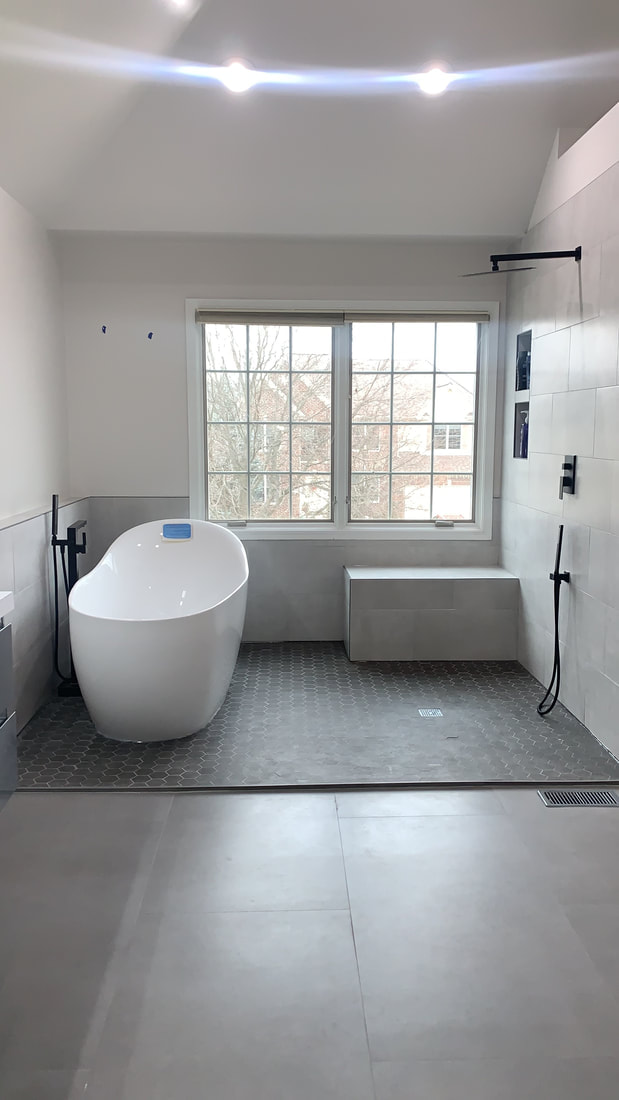
Full tub to shower conversion, custom Illinois-made floating vanity, Schluter Kerdi waterproofing membrane, 24 by 48 porcelain tile surround, frameless glass enclosure, Kohler fixtures, HOA-approved in four weeks. See more completed work in our project portfolio.
What a bathroom remodel returns at resale
A bathroom remodel is one of the more reliable improvements for holding value in Chicago. Mid-range projects typically recover 60 to 70 percent of their cost at resale and add meaningful value to the home. Just as important in a competitive market, an updated bathroom photographs well and removes a common objection during a walk-through, which helps a listing move faster. The smart play is to match the finish level to the home and the neighborhood: a clean, well-built mid-range remodel almost always pays its way better than an over-built luxury bath in a modest building.
What Chicago homeowners actually pay by type
Chicago's range of housing creates very different projects. Here is what real 2026 work costs, fully delivered.
| Bathroom Type | Size | Total Cost | Timeline |
|---|---|---|---|
| Powder room | 15 to 36 sq ft | $9K-$22K | 2 to 3 weeks |
| Guest bathroom | 36 to 64 sq ft | $20K-$38K | 3 to 5 weeks |
| Primary bathroom | 64 to 120 sq ft | $28K-$65K | 5 to 8 weeks |
| Tub to shower conversion | Any | $8K-$22K | 2 to 4 weeks |
| Luxury master suite | 120+ sq ft | $70K-$100K+ | 8 to 12 weeks |
Per square foot, Chicago bathroom work runs roughly $70 for basic finishes to $250 for designer-level work. A small bathroom with luxury materials can easily cost more than a large bathroom with standard ones, which is why per-room ranges are usually more useful than per-square-foot math.
Your building drives the price as much as your tile
The single biggest variable in Chicago is not the bathroom. It is the structure around it. Here is how cost shifts across the three building types we work in most.
Buildings we regularly work in include 680 N Lake Shore Drive, 111 E Chestnut, The Pinnacle, and Harbor Point, plus 300 others. We know the managers, the HOA requirements, and the freight elevator schedules before your project starts.
- HOA submission package: architect-stamped plans, insurance, timeline, and debris management, all prepared by us.
- HOA approval timeline: 4 to 8 weeks typical, as fast as 2 weeks in buildings we have worked in before.
- Freight elevator fees: $500 to $1,200, with reservations coordinated to minimize trips.
- Work-hour restrictions: usually weekdays 8am to 5pm, built into the schedule upfront.
- Waterproofing documentation: most boards require photo proof before tile, which we provide as standard.
Older Chicago buildings hide their costs behind the walls until demolition day. Budget for the surprises that show up in most of them.
- Galvanized pipe replacement: $2,500 to $4,000, common once walls open in pre-1960 buildings.
- Knob-and-tube electrical: $1,500 to $2,800 to update for modern bathroom loads.
- Hidden water damage: $800 to $2,000, found in 60 to 70 percent of vintage demo projects.
- Mold remediation: $600 to $1,500, a frequent discovery given Chicago humidity and poor historic ventilation.
- Lead-safe protocols: required in pre-1978 homes, handled correctly by our certified crews.
The most flexible scenario, with the fewest gatekeepers and the most room to expand.
- No condo board approvals, which means a faster start to finish.
- Expansion potential from adjacent closets or rooms.
- Room for spa amenities such as a freestanding tub, steam shower, or radiant floor.
- Higher ROI, since premium bathrooms strongly boost single-family home value.
What actually separates one bathroom contractor from another
Not all Chicago bathroom contractors are equal, and the differences that matter are rarely the ones in the brochure. Here is what to compare on the points that protect your project and your home.
| What Matters | Typical Contractor | Assembly Squad |
|---|---|---|
| Workmanship warranty | 1 year | 2 years ✓ |
| IL contractor license | Varies, always verify | #TGC098779 ✓ |
| BBB rating | Often unlisted | A+ rated ✓ |
| Waterproofing system | Generic membrane | Schluter Kerdi, named system ✓ |
| Vanity and cabinet source | National brands, long lead times | Illinois-made, 4 to 6 week lead ✓ |
| HOA-approved buildings | Unknown track record | 300+ Chicago buildings ✓ |
| Design studio | No physical showroom | 2315 N Southport, Lincoln Park ✓ |
| Chicago projects completed | Varies | 500+ since 2013 ✓ |
The most critical cost nobody can see
In a Chicago high-rise, a waterproofing failure is not a finish problem, it is a liability problem. Water reaching the ceiling of the unit below means damage claims, neighbor disputes, and HOA fines. That is why we use named waterproofing systems rather than generic membranes, and why we document everything before tile goes in.
The Schluter Kerdi system on every condo bathroom
We install named, proven waterproofing as standard on every high-rise and condo project:
- Schluter Kerdi: a bonded membrane installed over backer board that fully encapsulates the shower zone. Most Chicago boards accept Schluter documentation without third-party inspection.
- Wedi board: a waterproof foam composite used where shower walls need extra rigidity. Lighter, faster, and gap-free.
- RedGard: a liquid-applied secondary membrane for shower floors and wet-zone transitions under large-format tile.
- Photo documentation: we photograph all waterproofing before tile, which most Chicago associations require, provided on every project.
The surprises behind the walls in most older homes
Hidden costs show up in 60 to 70 percent of Chicago vintage building projects. They are not the exception here, they are the norm. The four below are the most common.
- Common in pre-1960 buildings.
- Cast iron or galvanized that has deteriorated.
- Must be addressed once exposed during demo.
- Adds 3 to 5 days to the timeline.
- Required for radiant heated floors.
- High-power vent fans need dedicated circuits.
- Knob-and-tube removal is legally required.
- Often discovered only when walls open.
- Behind tile and fixtures, invisible until demo.
- Under flooring and subfloor.
- Previous owners commonly tile over it.
- Found during demo in most vintage buildings.
- Chicago humidity plus poor historic ventilation.
- Behind shower walls and ceilings.
- Professional removal under EPA protocol.
- Resolved before any new tile is set.
Always set aside a 10 to 15 percent contingency
Hidden costs are normal in Chicago bathroom renovations, not rare. We price the likely surprises upfront based on building age and type, but every homeowner should budget 10 to 15 percent on top of any quoted price so a discovery during demo does not become a crisis.
Where your money actually goes
| Category | Share | Range | What It Covers |
|---|---|---|---|
| Labor | 40 to 60% | $8K-$30K | Demo, plumbing, electrical, tile, vanity install, glass, paint, project management |
| Materials | 30 to 40% | $6K-$25K | Tile, vanity, fixtures, toilet, membrane, backer board, grout, glass enclosure |
| Permits | 5 to 10% | $800-$4.5K | City building, plumbing, and electrical permits, plus condo HOA submission fees |
| Contingency | 10 to 15% | $2K-$8K | Hidden infrastructure, plumbing surprises, mold, water damage |
Notice that labor, plumbing, and waterproofing together usually account for more than half the budget. That is the part you cannot see once the project is finished, and it is exactly the part that separates a bathroom that lasts twenty years from one that leaks in three.
Related guides and resources
What each price point buys you
- New vanity with smart storage, with Illinois-made custom vanities from $2,500
- Durable porcelain or luxury vinyl plank flooring for Chicago weather extremes
- Updated LED lighting compatible with older electrical
- Water-efficient Kohler or Toto toilet
- Modern fixtures, fresh paint, updated hardware
- Tub to shower conversion with Schluter Kerdi waterproofing, the same system used at 680 N Lake Shore Drive
- Custom vanity designed for Chicago floor plans, Illinois-made with no import delays
- Frameless glass enclosure that opens up a smaller bathroom
- Heated tile flooring, a Chicago winter necessity
- Upgraded ventilation with timer fans to fight humidity
- Double custom vanity, Illinois-manufactured with a 4 to 6 week lead time
- Separate walk-in shower and soaking tub
- Radiant heated floor, essential for Chicago winters
- Natural stone or large-format porcelain tile
- Premium Kohler, Brizo, or Hansgrohe fixtures
- Steam shower with body sprays and a rain ceiling head
- Freestanding designer soaking tub
- Imported marble or book-matched stone surfaces
- Custom cabinetry with integrated lighting and soft-close hardware
- Full radiant heat, heated towel racks, smart mirror
Five ways to save without cutting quality
Keep plumbing in its existing locations
Moving water lines and drain stacks in Chicago's older buildings adds $3,000 to $6,000 in plumbing and structural work. Keeping fixtures where they are puts that money into finishes instead.
Use Illinois-made custom vanities
We manufacture custom vanities locally with no import delays and a 4 to 6 week lead time. A custom floating vanity starts at $2,500 and outperforms a $4,000 imported piece. See our custom cabinetry options.
Schedule your project in winter
Many Chicago contractors offer lower rates from December through February when demand drops. Winter scheduling can save on labor while securing better crew availability.
Invest in statement pieces, save on the rest
A striking custom vanity carries a room with standard tile behind it. A frameless glass shower creates impact without replacing every surface. One great fixture or material delivers more visual return per dollar than spreading the budget evenly.
Visit the design studio before you buy
See full-size tile, vanity samples, and fixture mockups before committing. Most expensive material mistakes happen because the homeowner only saw photos online. Our studio at 2315 N Southport Ave is open by appointment, free and no obligation.
Is 2026 a good time to remodel?
Yes, and the window is favorable for two reasons. Material pricing has settled after several volatile years, and labor availability is better than it was in 2023 and 2024.
Conditions now
- Material costs stabilized after years of swings
- Specialty fixtures back to 6 to 8 week lead times
- Labor availability improved
- Better contractor scheduling flexibility
Lock in before increases
- Some imported tile and hardware seeing price increases
- Illinois-made vanities carry no import exposure
- Construction labor rising roughly 4 to 5 percent a year
- Contractor demand expected to surge late 2026
Starting now means better material availability, better crew scheduling, and pricing locked in before the anticipated late-2026 demand surge. We hold quoted prices for 60 days from the estimate date.
Chicago bathroom transformations
Real before-and-after results from high-rises, vintage homes, and condos across the city.
500+ remodels across Chicago
From vintage Logan Square bungalows to Streeterville high-rises, we know every neighborhood, building type, and HOA.
Chicago bathroom remodel cost, answered
How much does a bathroom remodel cost in Chicago in 2026?
Chicago bathroom remodels cost $9,000 to $100,000 or more in 2026. Powder rooms average $9,000 to $22,000, guest bathrooms run $20,000 to $38,000, primary bathrooms cost $28,000 to $65,000, and high-end luxury renovations exceed $70,000. Chicago runs roughly 15 to 25 percent above the national average because of aging housing stock, strict building codes, condo restrictions, and infrastructure surprises in vintage buildings. Assembly Squad provides transparent fixed-price proposals under IL License #TGC098779.
How much does a high-rise condo bathroom remodel cost in Chicago?
A high-rise condo bathroom remodel in Chicago costs $20,000 to $45,000 for a standard full renovation, and $45,000 to $80,000 or more for a luxury gut. Add $2,000 to $4,000 for building-specific costs: HOA submission fees of $300 to $700, freight elevator reservations of $500 to $1,200, and enhanced waterproofing documentation. Assembly Squad recently completed a full tub to shower conversion at 680 N Lake Shore Drive in Streeterville for $31,000 in two and a half weeks, and is HOA-approved in 300-plus buildings.
How much does a tub to shower conversion cost in Chicago?
A tub to shower conversion in Chicago costs $8,000 to $22,000. A basic conversion with a standard tile surround runs $8,000 to $12,000. A custom walk-in shower with large-format tile, Schluter Kerdi waterproofing, a frameless glass enclosure, and a built-in niche costs $14,000 to $22,000. In high-rise condos, budget an extra $2,000 to $3,000 for building coordination, waterproofing documentation, and elevator logistics.
What waterproofing is required for a Chicago condo bathroom?
Chicago condo boards require a continuous waterproof membrane in all wet areas before tile installation. Most buildings accept Schluter Kerdi, Wedi board, or RedGard liquid membrane, with all seams, corners, and plumbing penetrations fully sealed. Many associations require photographic proof before tile goes in. Assembly Squad uses Schluter Kerdi as standard on all high-rise projects and provides full photo documentation on every job.
How long does a bathroom remodel take in Chicago?
Active construction takes 2 to 8 weeks. Powder rooms take 2 to 3 weeks, guest bathrooms 3 to 5 weeks, and primary bathrooms 5 to 8 weeks. Add 2 to 4 weeks for a city permit before construction, and 4 to 8 weeks for HOA approval in condo buildings. The total from first consultation to move back in is typically 8 to 16 weeks for a full bathroom renovation.
What are the hidden costs in a Chicago bathroom remodel?
Hidden costs appear in 60 to 70 percent of Chicago vintage building projects. The common ones are galvanized pipe replacement ($2,500 to $4,000), electrical upgrades ($1,500 to $2,800) for heated floors, water damage repair ($800 to $2,000) behind tile, mold remediation ($600 to $1,500), and condo freight elevator fees ($500 to $1,200). Always budget a 10 to 15 percent contingency on top of your quoted price.
What permits are needed for a Chicago bathroom remodel?
Chicago bathroom remodels involving plumbing, electrical, or structural work require a building permit plus separate plumbing and electrical permits, generally totaling $800 to $2,500. Approval usually takes a few weeks. Assembly Squad handles all permit applications and city inspections as part of every project, included in the proposal rather than added later. Unpermitted work risks fines and complications at resale.
Is a bathroom remodel worth it in Chicago?
Yes. Chicago bathroom remodels typically recover 60 to 70 percent of their cost at resale and help a home sell faster by removing a common buyer objection. For condo owners, an updated bathroom is often the highest-impact single improvement for both resale and daily quality of life, especially when upgrading from original builder-grade finishes.
How do I choose the right bathroom remodeler in Chicago?
Verify the Illinois general contractor license, check the BBB rating, and ask about the workmanship warranty. Ask what waterproofing system they use by name, and if they cannot name one, keep looking. Ask for references from your specific building type, and get three to four detailed itemized quotes so you can compare scope, not just price. Assembly Squad has completed 500-plus Chicago bathroom renovations since 2013 and offers a free consultation at its Lincoln Park studio.
How much does a walk-in shower conversion cost in Chicago?
A tub to walk-in shower conversion in Chicago typically costs $8,000 to $22,000 depending on tile, glass enclosure, and whether plumbing lines move. In high-rise condos, waterproofing requirements add $1,500 to $3,000. A curbless, zero-threshold shower adds $1,200 to $2,500 for the membrane and linear drain. Assembly Squad has completed walk-in shower conversions in 300-plus Chicago condo buildings.
See exactly what your bathroom will cost
Get a detailed, itemized estimate from a licensed Chicago bathroom remodeling contractor. Fixed-price proposals, a 2-year workmanship warranty, and 500-plus projects since 2013. No vague numbers and no pressure.
(312) 544-9150HQ: 205 N Michigan Ave Suite 810 · Lincoln Park Design Studio: 2315 N Southport Ave · (312) 544-9150 · assemblyserviceil.com
This guide is editorial reference content for Chicago homeowners planning a bathroom remodel. Cost ranges, timelines, and permit figures reflect 2026 Chicago market conditions and Assembly Squad's design-build practice across 500+ projects. Individual project pricing varies by scope, building, condition, and finish level; a fixed-price proposal is the starting point for any specific project. Permit requirements and fees should be verified with the City of Chicago Department of Buildings. Resale recovery figures are based on national remodeling data and vary by market. Information current as of 2026.